| 存储条件 | -20℃ |
|---|
Human IgG ELISA Kit is a sandwich ELISA used to quantify Human IgG with a sensitivity of 20 pg/mL.
- Colorimetric sandwich ELISA - 450 nm readout - works on any plate reader
- Validated on a number of sample types including serum and plasma
- Wide dynamic range – quantifies 0.02 - 15 ng/mL

Colorimetric
Plasma, Serum
Human
Sandwich (quantitative)
< 20 pg/mL
0.02 - 15 ng/mL
Microplate
Human IgG ELISA Kit ab100547 is a sandwich ELISA kit to measure Human IgG in Serum and Plasma with a sensitivity of 20 pg/mL.
How the assay works
Human IgG ELISA Kit ab100547 employs an antibody specific for Human IgG coated on a 96-well plate. Standards and samples are pipetted into the wells and IgG present in a sample is bound to the wells by the immobilized antibody. The wells are washed and biotinylated anti-Human IgG antibody is added. After washing away unbound biotinylated antibody, HRP-conjugated Streptavidin is pipetted to the wells. The wells are again washed, a TMB substrate solution is added to the wells and color develops in proportion to the amount of IgG bound. The Stop Solution changes the color from blue to yellow, and the intensity of the color is measured at 450 nm.
Assay Specificity
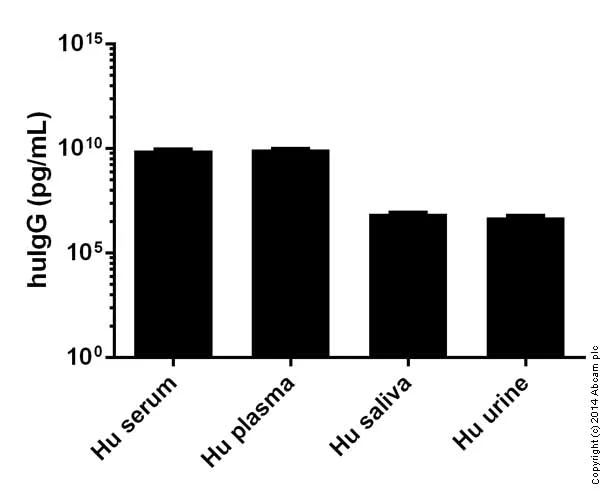
This kit recognizes both native human IgG in serum, plasma, saliva, and urine samples.
Human IgG ELISA Kit ab100547 protocol summary:
1. Add samples and standards to wells. Incubate at room temperature.
2. Wash each well and add biotin-antibody conjugate. Incubate at room temperature.
3. Wash each well and add Streptavidin Solution. Incubate at room temperature.
4. Add TMB Solution to each well. Incubate at room temperature.
5. Add Stop Solution to each well. Read immediately.
How other researchers are using Human IgG ELISA Kit ab100547
Human IgG ELISA Kit ab100547 has been used to characterize and quantify recombinant antibodies for establishing IgG production platforms (1), to isotype and study antibodies associated with nephropathy (2), and to quantify IgG contamination when developing a PEG-precipitation method to evaluate clinical cancer biomarkers in serum (3).
References:
(1) J.S. Park, et.al., 2023, PMID: 37264071
(2) Y.J. Cheng, et.al., 2023, PMID: 37020299
(3) M. Wang, et.al., 2022, PMID: 36497452
Get results in 90 minutes with our SimpleStep ELISA® kit
- Human IgG ELISA Kit ab195215
- Human IgG ELISA Kit (10 x 96 well plate) ab212169
- Human IgG ELISA Kit, Fluorescent ab229390
Isotype Specific
- Human IgG1 ELISA Kit ab317543
- Human IgG2 ELISA Kit ab202402
- Human IgG3 ELISA Kit ab318929
- Human IgG4 ELISA Kit ab320788
The Human immune system consists of two functional components classified as the innate system (the physical, biochemical and cellular barriers), and the adaptive immune system (including lymphocytes and immunoglobulins). Immunoglobulins are the key elements of the humoral immune response in vertebrate against parasitic invasion.
The polypeptide chains of immunoglobulins composed of two identical heavy (H) chains and two identical light (L) chains linked together by inter-chain disulfide bonds. While the amino-terminal portions that exhibits highly variable amino-acid composition are involved in antigen binding, the C terminal constant parts are involved in complement binding, placental passage and binding to cell membranes. Based upon the variation of the constant region of the heavy chain, nine immunoglobulin heavy chain isotypes are found in humans: IgA (with subclasses IgA1 and IgA2), IgD, IgE, IgM, and IgG (with subclasses IgG1, IgG2, IgG3, and IgG4).
IgG is the predominant immunoglobulin in the serum, which accounts for 75% of the total serum antibody of healthy individuals. IgG has a molecular weight of about 150 kDa. Four distinct subgroups of human IgG (IgG1, IgG2, IgG3, and IgG4) were first demonstrated in the 1960's by using polyclonal antisera prepared in animals immunized with human myeloma proteins.
The capture antibody of the kit ab100547 detects the Fc portion of the heavy chain of all subclasses of human IgG and the detection antibody detects the F(ab')2 fragment of IgG.
Blue Ice
-20°C
-20°C
-20°C
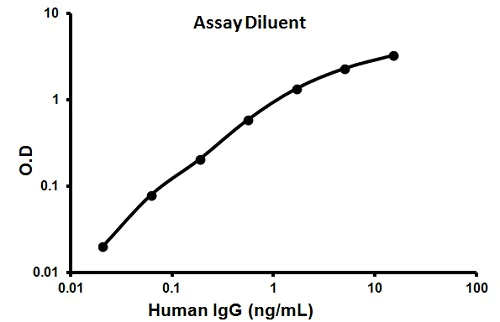
Representative standard curve using ab100547
抱歉,暂无相关文献