| 存储条件 |
|---|
| Product Name | CELF2 |
|---|---|
| Antibody Type | Primary Antibodies |
| Antigen Alias | Bruno-like protein 3 antibody BRUNOL3 antibody Cardiac elav type RNA binding protein antibody CELF-2 antibody celf2 antibody CELF2_HUMAN antibody CUG BP2 antibody CUG triplet repeat RNA-binding protein 2 antibody CUG-BP- and ETR-3-like factor 2 antibody CUG-BP2 antibody CUGBP Elav like family member 2 antibody CUGBP Elav-like family member 2 antibody CUGBP2 antibody dJ323N1.1 antibody elav type RNA binding protein antibody ELAV-type RNA-binding protein 3 antibody ETR 3 antibody ETR-3 antibody ETR3 antibody HGNC:2550 antibody hNAPOR antibody NAPOR 2 antibody NAPOR antibody Neuroblastoma apoptosis-related RNA-binding protein antibody Neuroplastoma apoptosis related RNA binding protein 3 antibody RNA binding protein BRUNOL3 antibody RNA-binding protein BRUNOL-3 antibody |
| Product description | Myotonic dystrophy (DM) is an autosomal dominant neuromuscular disease that is associated with a (CTG)n repeat expansion in the 3'-untranslated region of the myotonin protein kinase gene (DMPK). CUG-BP1 and CUG-BP2 are proteins that bind specifically to (CUG)8 oligonucleotides in vitro. While CUG-BP1 has the major binding activity in normal cells, nuclear CUG-BP2 binding activity increases in DM cells. Both CUG-BP1 and CUG-BP2 are isoforms of a novel heterogeneous nuclear ribonucleoprotein (hnRNP), hNab50. CUG-BP1, an RNA CUG triplet repeat binding protein, regulates splicing and translation of various RNAs. Expansion of RNA CUG repeats in the DMPK in DM is associated with alterations in binding activity of CUG-BP1 as well as alterations in the translation of the C/EBPb transcription factor. CUG-BP1 is an important regulator of initiation from different AUG codons of C/EBPb mRNA. In normal cells, CUG-BP1 up-regulates the p21 protein during differentiation by inducing the translation of p21 via binding to a GC-rich sequence located within the 5' region of p21 mRNA. In DM cells, failure to accumulate CUG-BP1 leads to a reduction of p21 and alterations in other proteins responsible for cell cycle withdrawl. |
| Immunogen | Peptide |
| Clonality | Polyclonal |
|---|---|
| Isotype | IgG |
| Host Species | Rabbit |
| Tested Applications | WBICC |
| WB:1:500-1:2,000 ICC:1:50-1:200 | |
| Species Reactivity | HumanMouseRat |
| Concentration | 1mg/ml |
| Alternative Names | Bruno-like protein 3 antibody BRUNOL3 antibody Cardiac elav type RNA binding protein antibody CELF-2 antibody celf2 antibody CELF2_HUMAN antibody CUG BP2 antibody CUG triplet repeat RNA-binding protein 2 antibody CUG-BP- and ETR-3-like factor 2 antibody CUG-BP2 antibody CUGBP Elav like family member 2 antibody CUGBP Elav-like family member 2 antibody CUGBP2 antibody dJ323N1.1 antibody elav type RNA binding protein antibody ELAV-type RNA-binding protein 3 antibody ETR 3 antibody ETR-3 antibody ETR3 antibody HGNC:2550 antibody hNAPOR antibody NAPOR 2 antibody NAPOR antibody Neuroblastoma apoptosis-related RNA-binding protein antibody Neuroplastoma apoptosis related RNA binding protein 3 antibody RNA binding protein BRUNOL3 antibody RNA-binding protein BRUNOL-3 antibody |
|---|---|
| Molecular Weight(MW) | 54 kDa |
| Cellular Localization | Nucleus. Cytoplasm. |
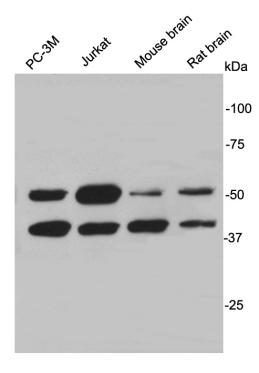
Application
Fig1: Western blot analysis of CELF2 on Jurkat cell lysate using anti-CELF2 antibody at 1/2,000 dilution.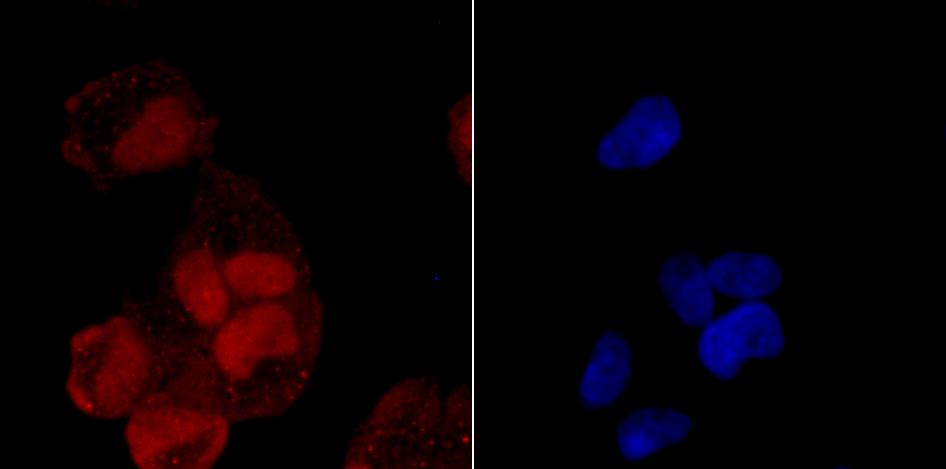
Application
Fig2: ICC staining CELF2 in Hela cells (red). The nuclear counter stain is DAPI (blue). Cells were fixed in paraformaldehyde, permeabilised with 0.25% Triton X100/PBS.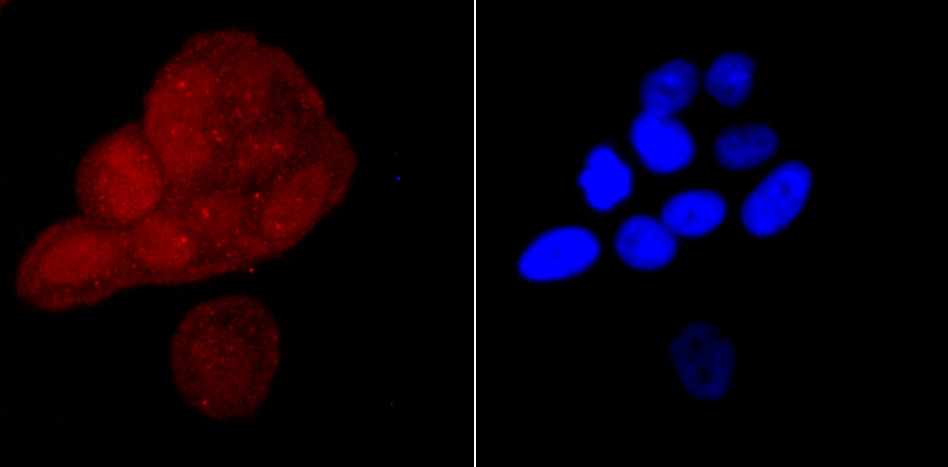
Application
Fig3: ICC staining CELF2 in MCF-7 cells (red). The nuclear counter stain is DAPI (blue). Cells were fixed in paraformaldehyde, permeabilised with 0.25% Triton X100/PBS.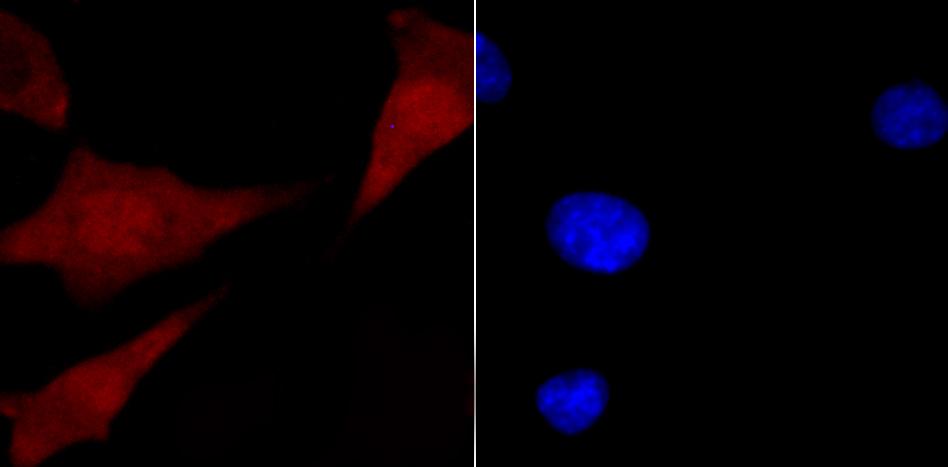
Application
Fig4: ICC staining CELF2 in SHG-44 cells (red). The nuclear counter stain is DAPI (blue). Cells were fixed in paraformaldehyde, permeabilised with 0.25% Triton X100/PBS.| Positive Control | Jurkat cell lysate, Hela, MCF-7, SHG-44. |
|---|---|
| Application Notes | WB:1:500-1:2,000 ICC:1:50-1:200 |
| Form | Liquid |
|---|---|
| Storage Instructions | Store at +4℃ after thawing. Aliquot store at -20℃ or -80℃. Avoid repeated freeze / thaw cycles. |
| Storage Buffer | 1*TBS (pH7.4), 1%BSA, 40%Glycerol. Preservative: 0.05% Sodium Azide. |
抱歉,暂无相关文献