| 存储条件 |
|---|
| Product Name | APEX1 |
|---|---|
| Antibody Type | Primary Antibodies |
| Antigen Alias | APE; APX; APE1; APEN; APEX; HAP1; REF1 |
| Immunogen | Purified recombinant fragment of human APEX1 (AA: 219-318) expressed in E. Coli. |
| Clonality | Monoclonal |
|---|---|
| Isotype | Unknown |
| Host Species | Unknow |
| Tested Applications | WBIHCFCMICC/IF |
| WB:1:250~1:1000 IHC:1:20~1:100 ICC/IF:1:100~1:200 Notes:Optimal dilutions/concentrations should be determined by the researcher. | |
| Species Reactivity | HumanMonkeyRat |
| Purification | Unpurified |
| Alternative Names | APE APX APE1 APEN APEX HAP1 REF1 |
|---|---|
| Molecular Weight(MW) | 35.6kDa |
| Entrez Gene | 328 |
|---|
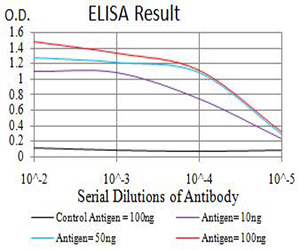
Application
Figure 1:Black line: Control Antigen (100 ng);Purple line: Antigen (10ng); Blue line: Antigen (50 ng); Red line:Antigen (100 ng)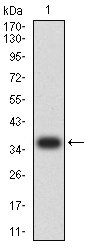
Application
Figure 2:Western blot analysis using APEX1 mAb against human APEX1 (AA: 219-318) recombinant protein. (Expected MW is 37.4 kDa)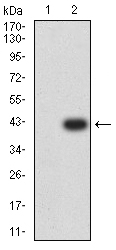
Application
Figure 3:Western blot analysis using APEX1 mAb against HEK293 (1) and APEX1 (AA: 219-318)-hIgGFc transfected HEK293 (2) cell lysate.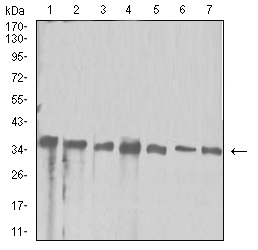
Application
Figure 4:Western blot analysis using APEX1 mouse mAb against Hela (1), Jurkat (2), SW480 (3), A431 (4), HepG2 (5), NIH/3T3 (6), and PC-12 (7) cell lysate.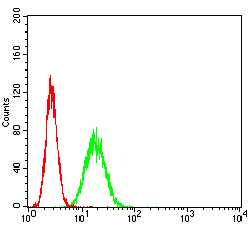
Application
Figure 5:Flow cytometric analysis of HeLa cells using APEX1 mouse mAb (green) and negative control (red).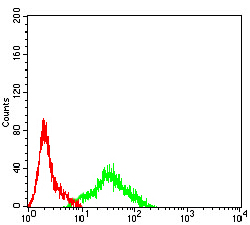
Application
Figure 6:Flow cytometric analysis of SK-N-SH cells using APEX1 mouse mAb (green) and negative control (red).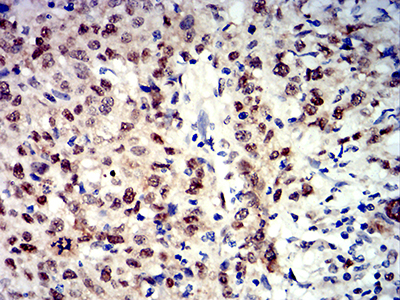
Application
Figure 7:Immunohistochemical analysis of paraffin-embedded breast cancer tissues using APEX1 mouse mAb with DAB staining.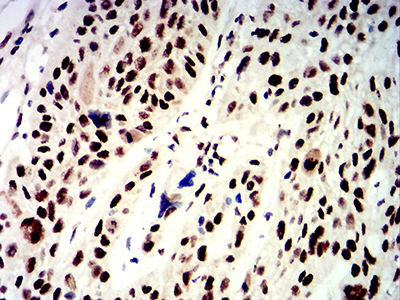
Application
Figure 8:Immunohistochemical analysis of paraffin-embedded esophageal cancer tissues using APEX1 mouse mAb with DAB staining.| Application Notes | WB:1:250~1:1000 IHC:1:20~1:100 ICC/IF:1:100~1:200 Notes:Optimal dilutions/concentrations should be determined by the researcher. |
|---|
| Form | Purified antibody in PBS with 0.05% sodium azide |
|---|---|
| Storage Instructions | 4℃; -20℃ for long term storage |
抱歉,暂无相关文献