| 存储条件 |
|---|
| Product Name | Mst3 [1G8] |
|---|---|
| Antibody Type | Primary Antibodies |
| Antigen Alias | epididymis secretory protein Li 95 antibody HEL-S-95 antibody Mammalian STE20 like protein kinase 3 antibody Mammalian STE20-like protein kinase 3 antibody Mammalian STE20-like protein kinase 3 C-terminal antibody Mammalian STE20-like protein kinase 3 N-terminal antibody Mammalian sterile 20-like 3 antibody MST-3 antibody MST3/C antibody MST3/N antibody MST3B antibody serine threonine kinase 24 antibody Serine/threonine kinase 24 (Ste20, yeast homolog) antibody Serine/threonine-protein kinase 24 12 kDa subunit antibody Serine/threonine-protein kinase 24 antibody STE20 homolog yeast antibody STE20 like kinase MST3 antibody STE20-like kinase MST3 antibody Stk24 antibody STK24_HUMAN antibody STK3 antibody |
| Product description | Sterile-20 (STE20) is a serine/threonine kinase in Saccharomyces cerevisiae that is involved in relaying signals from G protein-coupled receptors to cytosolic MAP kinase cascades. Mammalian protein kinases that display sequence similarity to STE20 are divided into two groups, the PAK subfamily and the GCK subfamily. The PAK subfamily members contain a C-terminal catalytic domain and an N-terminal regulatory domain with a p21Rac/Cdc42-binding site, and these kinases can activate both p38 MAPK and JNK. The GCK subfamily members contain a C-terminal regulatory domain and an N-terminal catalytic domain, and they have diverse roles in many pathways, including the activation of ERK, JNK, p38 MAPK, and caspase-3. The mammalian STE20-like kinases (MST kinases, also known as Ksr proteins) are members of the GCK subfamily. Ksr-1 and Ksr-2 (also known as MST-2 and MST-1, respectively) are both direct substrates of caspase-3 that accelerate caspase-3 activation. MST-3 is ubiquitously expressed in mammalian tissue and can phosphorylate exogenous substrates as well as itself. MST-4 is highly expressed in placenta, thymus, and peripheral blood leukocytes, and it specifically activates ERK. |
| Immunogen | Amino acids 275-393 of MST-3 of human origin. |
| Clonality | Monoclonal |
|---|---|
| Isotype | IgG1 |
| Host Species | Mouse |
| Tested Applications | WBIPIF |
| WB:1:100-1:1,000 IP:1-2 μg per 100-500 μg of total protein(1 ml of cell lysate) IF:1:50-1:500 | |
| Species Reactivity | HumanMouseRat |
| Concentration | 2mg/ml |
| Alternative Names | epididymis secretory protein Li 95 antibody HEL-S-95 antibody Mammalian STE20 like protein kinase 3 antibody Mammalian STE20-like protein kinase 3 antibody Mammalian STE20-like protein kinase 3 C-terminal antibody Mammalian STE20-like protein kinase 3 N-terminal antibody Mammalian sterile 20-like 3 antibody MST-3 antibody MST3/C antibody MST3/N antibody MST3B antibody serine threonine kinase 24 antibody Serine/threonine kinase 24 (Ste20 yeast homolog) antibody Serine/threonine-protein kinase 24 12 kDa subunit antibody Serine/threonine-protein kinase 24 antibody STE20 homolog yeast antibody STE20 like kinase MST3 antibody STE20-like kinase MST3 antibody Stk24 antibody STK24_HUMAN antibody STK3 antibody |
|---|---|
| Molecular Weight(MW) | 50/35 kDa |
| Cellular Localization | Cytoplasm, Nucleus, Membrane |
| SwissProt ID | Q9Y6E0 |
|---|
Application
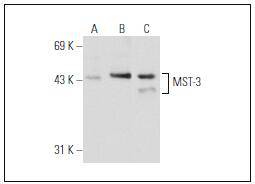
Fig1: Western blot analysis of MST-3 expression in non-transfected 293T (A), human MST-3 transfected 293T (B) and A-431 (C) whole cell lysates.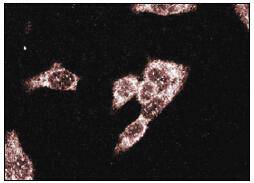
Application
Fig2: Immunofluorescence staining of HeLa cells showing cytoplasmic staining.| Positive Control | Hela, 293T, A-431. |
|---|---|
| Application Notes | WB:1:100-1:1,000 IP:1-2 μg per 100-500 μg of total protein(1 ml of cell lysate) IF:1:50-1:500 |
| Form | Liquid |
|---|---|
| Storage Instructions | Store at +4℃ |
| Storage Buffer | 1*TBS (pH7.4), 1%BSA, 40%Glycerol. Preservative: 0.05% Sodium Azide. |
抱歉,暂无相关文献
抱歉,暂无浏览记录